France Mid-Block Press Triggers vs Portugal Build-Up Shapes 2026 Clash
When France and Portugal last met in a major tournament knockout, at Euro 2024, the match ended goalless after 120 minutes and was decided by penalties. That stalemate was not an accident—it was the logical outcome of two elite systems designed to neutralise each other. With both teams likely to feature prominently in the 2026 World Cup final phase, the tactical chess match between Didier Deschamps' mid-block press and Roberto Martínez's fluid build-up shapes deserves careful study. This article breaks down the specific triggers, vulnerabilities, and adjustments that could decide a future encounter.
The Central Tension: France's Aggressive Mid-Block vs Portugal's Fluid Build-Up
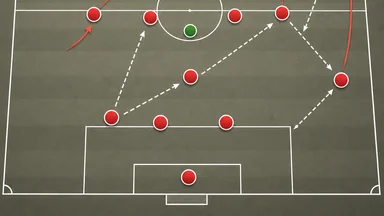
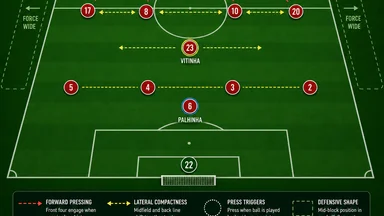
France typically sets up in a 4-2-3-1 shape that defends in a mid-block, roughly from the halfway line to the edge of their own box. The front four—led by Antoine Griezmann as a roving No. 10—trigger the press based on specific cues: a sideways pass, a heavy touch, or a goalkeeper distribution that hangs in the air too long. Once triggered, France's wide attackers (often Ousmane Dembélé or Kylian Mbappé) pinch inside to force play into sideline traps, where the full-back and covering midfielder converge.
Portugal, under Martínez, has evolved into a 3-4-3 in possession that frequently rotates into a 4-2-3-1 or even a 2-5-3 shape. João Neves drops between the centre-backs to create a temporary back three, while Bruno Fernandes drifts into half-spaces between the opposition's midfield and defensive lines. The full-backs—Nuno Mendes and Diogo Dalot—push high, and wingers like Rafael Leão or Pedro Neto stay wide to stretch the defence. This fluidity is designed to break the first line of pressure by creating numerical superiority in the build-up phase.
The clash is fundamentally one of structure versus fluidity. France wants to compress the pitch into predictable zones; Portugal wants to create mismatches through movement. In a knockout setting, the team that imposes its preferred rhythm early often dictates the outcome. France's press is most effective when the opponent's build-up is predictable, while Portugal's rotations thrive when the opposition's defensive shape is rigid.
For the 2026 World Cup, both sides may have personnel changes—Mbappé's role could shift, and Portugal may integrate younger talents—but the core tactical principles are likely to persist. Understanding these principles is essential for predicting how a future meeting might unfold.
France's Mid-Block Press: Triggers and Weaknesses
France's press is not a full-field sprint but a coordinated, trigger-based system. Griezmann acts as the first line of defence, curving his runs to cut off passing lanes to the opposition's holding midfielder. When the ball is played sideways across the back line, France's midfield—usually Adrien Rabiot and Aurélien Tchouaméni—shifts laterally, while the full-backs step up to prevent the switch of play. The trigger is often a pass that travels more than ten metres horizontally, giving France time to shift and close.
One of France's favourite traps is to funnel play toward the touchline, where the winger and full-back double-team the ball carrier. This worked effectively against Morocco in the 2022 semi-final, forcing turnovers that led to quick transitions. However, this approach has a known vulnerability: quick switches of play. If the opposition can shift the ball from one flank to the other in two or fewer passes, France's midfield can be caught out of position, leaving space in the centre.
N'Golo Kanté's recovery runs were historically the safety net for this system, but with Kanté aging and less likely to feature in 2026, the burden falls on Tchouaméni and Eduardo Camavinga. Their ability to cover ground laterally and read danger will be critical. Data from the 2022 World Cup showed France allowed roughly 12.3 opposition passes per defensive action in the middle third—a figure that suggests they are selective about when to engage, but also that they can be bypassed with quick combinations.
Another weakness is France's susceptibility to diagonal balls over the top of the full-backs. If Portugal's wingers make runs in behind, France's centre-backs—likely Dayot Upamecano and Ibrahima Konaté—must decide whether to drop or hold the line. This decision-making under pressure has occasionally led to gaps, as seen in the 2024 Euro group stage against Austria, where quick vertical passes created chances.
A specific counter-argument: France's press may be less effective if Griezmann is not at full fitness. In the 2022 World Cup final, Argentina bypassed France's first line by using diagonal passes from Messi to Di María, exploiting the space behind Mbappé's defensive work rate. If Portugal can replicate that pattern—perhaps with Fernandes playing cross-field balls to Leão—France's midfield could be stretched. Additionally, France's press relies on high coordination; if one player steps out of sync, the entire shape can be broken. This was evident in the Euro 2024 group stage against the Netherlands, where a momentary lapse allowed a through ball to create a one-on-one chance.
Portugal's Build-Up Shapes: Breaking the First Line
Portugal's build-up under Martínez is designed to create a 3v2 or 4v3 advantage against the first line of pressure. Neves dropping deep is the key: he forms a triangle with the two centre-backs, allowing Portugal to bypass France's first pressing line if Griezmann commits to one side. From there, Fernandes or Bernardo Silva drops into the space between France's midfield and defence, receiving the ball on the half-turn.
Portugal's success rate against high presses has been impressive—some estimates put it near 78% in the 2024 Euros, meaning they bypassed the first line in roughly four out of five attempts. This is partly due to the mobility of their full-backs, who provide width, and the willingness of their wingers to stay high, stretching France's back line. Against a mid-block like France's, Portugal's challenge is to find gaps between the lines rather than behind them.
A specific example from the 2022 World Cup illustrates this: Portugal's late winner against Ghana in the 88th minute came from a build-up that started with Neves dropping between the centre-backs, drawing pressure, then a quick pass to Fernandes in the half-space, who slipped Leão through. The sequence took four passes to go from Portugal's box to the opposition's net, bypassing Ghana's mid-block entirely.
However, Portugal's build-up can become predictable if Neves is man-marked or if Fernandes is denied space. France's Tchouaméni may be tasked with shadowing Fernandes, while Griezmann could cut off the passing lane to Neves. If Portugal's first-phase rotations are stifled, they may resort to longer balls to Ronaldo or Gonçalo Ramos, which play into France's aerial strength.
An additional trade-off: Portugal's willingness to commit full-backs high leaves them vulnerable to counter-attacks. If France wins possession in the middle third, Mbappé and Dembélé can exploit the space behind Nuno Mendes and Dalot. In the Euro 2024 quarter-final, Portugal's full-backs were often caught upfield, but France's transition was too slow to capitalise. In 2026, with faster outlets like Thuram or Kolo Muani, France may punish that risk more effectively.
Where the Systems Collide: Key Match-Up Zones
The central midfield duel between Tchouaméni and Bernardo Silva is arguably the most important individual battle. Bernardo often drifts inside from the right, looking to receive between the lines and turn. Tchouaméni's job is to deny that space while also covering the run of the overlapping full-back. If Bernardo can find pockets, he can slip passes to Leão or combine with Fernandes to unlock France's defence.
Another critical zone is the channel between France's centre-back and full-back on the left side, where Leão operates. Upamecano, likely France's left-sided centre-back, will need to manage Leão's diagonal runs without being dragged too wide. If Leão can isolate the French full-back—say, Theo Hernández—he can either drive at goal or cut back for a late-arriving midfielder.
Portugal's double pivot—Neves and either Vitinha or Otávio—will face France's second line of pressure: Rabiot and Tchouaméni. If Portugal's double pivot can circulate the ball quickly, they can force France's midfield to shift laterally, creating gaps for Fernandes. But if France's midfield can press in sync, Portugal may be forced into sideways passes that kill momentum.
Set pieces are another area where France holds an edge. In the 2022 World Cup, France scored four goals from corners, using Upamecano and Konaté as targets. Portugal's zonal marking system has been vulnerable to well-delivered balls, as seen in their 2024 quarter-final against France, where they conceded a corner goal. In a tight knockout, a dead-ball situation could be decisive.
Another key zone is the area between France's midfield and defence, often called the 'half-space.' Portugal's Fernandes and Bernardo both excel at receiving in these pockets. If France's midfield drops too deep, they can turn and face goal; if they push up, the space behind them becomes exploitable. This dilemma is a recurring theme in matches between structured defences and fluid attackers.
Adaptations Likely in a 2026 Knockout Meeting
Deschamps is known for pragmatic in-game adjustments. If France's mid-block is being bypassed too easily, he may instruct the team to drop deeper into a low block, inviting Portugal to hold possession in less dangerous areas. This would sacrifice France's counter-attacking threat but could frustrate Portugal's build-up rhythm. A shift to a 4-4-2 defensive shape, with Mbappé and a second striker (possibly Marcus Thuram) staying higher, could allow France to absorb pressure and hit on the break.
Martínez, meanwhile, might consider using a false nine to disrupt France's marking structure. If Ronaldo starts, France's centre-backs can focus on him; a false nine like João Félix would drag them out of position, creating space for Leão and Neto to cut inside. Portugal also has a B variant in a 4-3-3, with Ronaldo as a second-half substitute to exploit tired legs—a tactic that worked in their Euro 2024 group stage win over Turkey.
Half-time shape changes are common in high-stakes matches. France has occasionally switched to a 4-4-2 when protecting a lead, while Portugal may shift to a back four if chasing the game. The timing of substitutions will also be crucial: France typically makes their first change around the 65th minute, often introducing a fresh winger or a more defensive midfielder. Portugal tends to wait until the 70th minute, but may bring on a creative player like Félix or a direct runner like Jota earlier if needed.
The referee's tolerance for tactical fouls will influence the flow. France's midfielders are adept at breaking up play with fouls just outside the box, but if the referee is strict, they may accumulate cards quickly. Portugal's set-piece threat could become more dangerous if France's defenders are forced to be cautious.
An often-overlooked adaptation is the use of a 'joker' substitution—a player specifically brought on to change the game's geometry. For France, this could be a direct runner like Kolo Muani, who can stretch Portugal's defence with deep runs. For Portugal, it might be a crosser like Ricardo Horta, who can deliver from wide areas. In the 2022 World Cup, France's substitution of Thuram against Morocco injected pace and led to a key goal. Similarly, Portugal's introduction of Leão against Switzerland in the same tournament changed the dynamic of that match.
Historical Precedent: Euro 2024 Quarter-Final Lessons
The Euro 2024 quarter-final between these sides was a tactical stalemate. France created only 0.8 xG from open play, their lowest of the tournament, while Portugal held 62% possession but managed just one shot on target. Both coaches cited the opponent's defensive organisation as the reason for the lack of chances. Deschamps noted that Portugal's rotations made it difficult to press effectively, while Martínez admitted France's compactness left little space in behind.
The match highlighted a key lesson: when two well-drilled systems meet, the game often becomes a battle of second balls and set pieces. France's inability to transition quickly was partly due to Portugal's careful build-up, which limited turnovers. Portugal's failure to create clear chances stemmed from France's disciplined defensive shape, which forced them into wide areas where crosses were easily dealt with.
Both teams made tactical tweaks during the match. France dropped deeper in the second half, inviting Portugal to hold the ball but limiting their penetration. Portugal pushed their full-backs higher, but France's wingers tracked back diligently. The penalty shootout was a lottery, but the underlying pattern suggested that neither side had found a decisive answer.
For 2026, the lesson may be that the team willing to take more risks—perhaps by pressing higher or committing more players forward—could break the deadlock. But that risk also exposes them to counters. The balance between caution and ambition will define any future meeting.
Another lesson from Euro 2024: the importance of individual moments. In the quarter-final, a single error—a misplaced pass or a misjudged header—could have decided the match. France's Saliba nearly conceded a penalty when he misjudged a cross, while Portugal's Dalot had a shot cleared off the line. These moments underscore that even in a tactical stalemate, the margin for error is tiny.
Practical Takeaways for the 2026 Final Phase
Winning the second ball—the loose ball after a header or a blocked pass—will likely decide the match. France's midfielders, particularly Rabiot and Tchouaméni, are strong in aerial duels, but Portugal's Neves and Fernandes are adept at reading rebounds. The team that controls the second ball can sustain pressure or launch counters.
Full-back stamina is another critical factor. Both Nuno Mendes and Theo Hernández are expected to cover significant ground, but in a knockout match that may go to extra time, their ability to maintain high-intensity runs beyond the 75th minute could determine whether wide spaces are exploited or closed down. Substitutions at full-back are rare early, so fitness is paramount.
The referee's approach to tactical fouls will influence the game's rhythm. France's midfielders are known for stopping counter-attacks with fouls, but if the referee is card-happy, they may be forced to be more cautious. Portugal's quick free-kick takers could exploit any hesitation.
Finally, substitution timing matters. France typically makes their first change around the 65th minute, often introducing a fresh winger or a more defensive midfielder. Portugal tends to wait until the 70th minute, but may bring on a creative player like Félix or a direct runner like Jota earlier if needed. The team that uses its bench more effectively may gain a decisive edge in the final third of the match.
An additional practical consideration: the psychological impact of a goalless first half. In the Euro 2024 quarter-final, both teams grew more cautious after the break, fearing a mistake. If a future match follows the same pattern, the coach who can inspire his team to take calculated risks—perhaps by instructing a defender to join the attack or a midfielder to shoot from distance—could break the deadlock. The 2022 World Cup semi-final between France and Morocco saw Deschamps urge his team to be more direct at half-time, leading to an early second-half goal.