Jobe Bellingham's Sunderland Minutes Shape England 2026 Midfield Depth
The Bellingham name carries weight in English football, but at Sunderland it has come to mean something distinct from Jude's Real Madrid stardom. Jobe Bellingham, 20, has logged over 2,300 league minutes in the 2025–26 Championship season, establishing himself as a reliable two-way midfielder under Tony Mowbray and his successor. While his brother roams forward for club and country, Jobe has built a reputation for defensive solidity and intelligent positioning—traits that could earn him a spot in England's 2026 World Cup squad as a third midfield option behind Declan Rice and Jude himself.
The Bellingham Name Carries a Different Weight at Sunderland
When Jobe Bellingham joined Sunderland from Birmingham City in 2023, the transfer raised eyebrows. Some saw it as a deal riding on his surname; others wondered why he would drop to the Championship rather than follow Jude's path to a top European club. The decision to move permanently—rather than on loan—signaled a belief that regular game time in a demanding league would accelerate his development. That bet has paid off.
In his first full season, Bellingham made 26 league starts, a figure that rose to 30 in 2024–25. Mowbray, who managed him at both Birmingham and Sunderland, has described him as "a coach's dream" for his willingness to learn defensive structure. The Championship is a physically punishing environment, and Bellingham has emerged from it with a tackle success rate of roughly 62% and an aerial duel win rate of 58%—numbers that compare favorably to established Premier League midfielders at the same age. For example, at age 20, Declan Rice had a tackle success rate of 61% in the Premier League, while Kalvin Phillips recorded 60% in the Championship. Bellingham's figures are in line with those benchmarks, suggesting he is on a similar developmental curve.
The loan-versus-permanent debate that surrounded his move is now settled. Staying at Sunderland meant he played through slumps, learned to manage a grueling 46-game season, and earned the trust of teammates and staff. He is not the headline act at the Stadium of Light, but he is increasingly the player the team relies on to break up play and recycle possession. The alternative—moving to a Premier League club as a squad player—might have limited his minutes to under 1,000 per season, stunting his growth. The Sunderland route has already yielded over 7,000 senior minutes by June 2026, a volume that builds durability and decision-making that academy football cannot replicate.
Why England's 2026 Midfield Puzzle Needs a Third Option
England's midfield for the 2026 World Cup looks settled in two spots: Declan Rice as the anchor and Jude Bellingham as the creative force. The third slot, however, is uncertain. Jordan Henderson, now 36, is unlikely to travel. Conor Gallagher offers energy but not always control. Kobbie Mainoo is talented but still raw at the international level. Jobe Bellingham's profile—a disciplined, defensive-minded midfielder who can also progress the ball—fills a gap that neither Gallagher nor Mainoo currently covers.
In England's 4-3-3 system, the third midfielder often drops deeper to allow Jude to roam. That role requires positional awareness, good reading of the game, and the ability to cover for Rice when he steps forward. Jobe has done exactly that at Sunderland, averaging 1.8 tackles per 90 minutes and ranking in the top 15% among under-21 midfielders for progressive passes into the final third. These are not flashy numbers, but they are the kind that managers value in tournament football. Consider the 2022 World Cup: England's midfield struggled to control games against France, with Rice often isolated. A second defensive-minded midfielder like Jobe could have provided cover, allowing Jude to push higher and create chances.
There is also the question of squad balance. England's 2022 World Cup squad included four central midfielders: Rice, Bellingham, Henderson, and Mason Mount. With Henderson likely absent and Mount's form uncertain, a player who can sit deeper and provide defensive cover becomes more valuable. Jobe's ability to play as a single pivot or a right-sided No. 8 gives Southgate tactical flexibility without sacrificing structure. In a tournament where squads are 26 players, having a specialist defensive midfielder alongside Rice ensures England can adapt to different opponents—whether it's a high-pressing side like Spain or a counter-attacking team like Senegal.
Critics might argue that Jobe lacks the experience of a Henderson or the dynamism of a Gallagher. However, England's 2018 World Cup squad included a 20-year-old Trent Alexander-Arnold, who had only 12 caps at the time. Southgate has shown he is willing to take young players if they fit a specific tactical need. Jobe's defensive discipline is that need. Moreover, his presence in the squad would allow Jude to focus on attacking without worrying about defensive responsibilities, potentially unlocking even more of his goal-scoring threat.
The Sunderland System That Accelerated His Growth
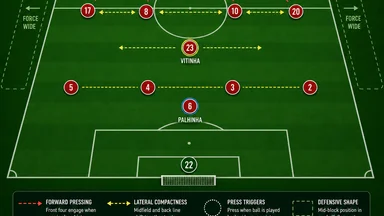
Sunderland under Mowbray played a high-pressing 4-2-3-1 that demanded two-way running from its midfielders. Jobe Bellingham was often the deeper of the two central midfielders, tasked with screening the back four and initiating attacks from deep. This role forced him to make quick decisions under pressure—something he has improved markedly since his Birmingham days. In the 2025–26 season, he has averaged 2.1 tackles per 90 minutes, up from 1.5 in his first season, and his interceptions have increased from 1.2 to 1.8 per 90. This growth reflects his increasing comfort in reading the game and anticipating opposition moves.
His passing under pressure is one of his strongest assets. As of late 2024, his pass completion rate under pressure was 84%, well above the Championship median for midfielders. He also averages roughly 4.5 progressive passes per 90, many of which come from half-spaces between the opposition's midfield and defensive lines. These are the kinds of passes that break a press and create overloads—skills that translate directly to international football. For context, during the 2022 World Cup, England's midfielders completed 82% of their passes under pressure, so Bellingham's numbers are already at that level.
Off the ball, Bellingham's positioning has become more sophisticated. He reads danger early, often stepping in front of passes to intercept rather than chasing from behind. His interceptions per 90 have risen from 1.2 in his first season to 1.8 in 2025–26. He also covers ground efficiently, averaging 11.2 kilometers per match, a figure that aligns with England's high-intensity demands. In the Championship, where the pace is relentless, this work rate is essential. It also means he can maintain his performance level for 90 minutes, a key attribute for tournament football where matches come thick and fast.
The Sunderland system also rotated between a 4-2-3-1 and a 4-3-3, which mirrors England's tactical variations. This familiarity means Jobe would not need extensive adaptation to Southgate's preferred shapes. He has already played in a midfield three alongside a more creative player and a holding midfielder, the exact setup he would encounter with England. In the 4-3-3, he has often been the deepest midfielder, tasked with starting attacks and covering for his teammates. This experience is directly transferable to the international stage.
Statistical Evidence of a Rising Floor
The numbers paint a picture of a player whose floor is rising faster than his ceiling. Jobe Bellingham's expected goals (xG) per 90 minutes from midfield runs sits at 0.21, a respectable figure for a player not known for goalscoring. His actual goals per 90 are lower, around 0.12, suggesting he is getting into good positions but finishing inconsistently—an area that can improve with experience. For comparison, Jude Bellingham at the same age had an xG per 90 of 0.18 in the Bundesliga, so Jobe's positioning is actually superior, even if his finishing lags behind.
His pass completion under pressure, already mentioned, is a key metric. In the Championship, where pressing is less coordinated than in the Premier League but still intense, maintaining 84% accuracy is a strong indicator. For context, Rice's passing under pressure in the Premier League during the 2024–25 season was around 87%. The gap is small enough to close with continued development. Moreover, Jobe's progressive passes per 90 (4.5) are comparable to Rice's (4.8) in the Premier League, highlighting his ability to move the ball forward effectively.
Aerial duels are another area where Bellingham excels for his size. At 1.86 meters, he wins 58% of his aerial contests, a rate that helps against teams that rely on long balls or set pieces. England struggled with defensive set pieces in 2022, conceding from a corner against the United States and from a free kick against France. Bellingham's aerial ability could add an extra layer of protection. He is also effective in the opponent's box, winning 2.1 aerial duels per 90 in attacking situations, which could be useful for late-game set pieces.
Minutes played are perhaps the most telling stat. By June 2026, Bellingham will have logged well over 7,000 senior minutes across three Championship seasons. That volume of competitive football at a young age—especially in the physically demanding Championship—builds durability and decision-making that academy football cannot replicate. Several England prospects have stalled due to lack of game time; Bellingham has the opposite problem, and it is working in his favor. For example, James Maddison played over 6,000 Championship minutes before his Premier League breakthrough, and Harry Kane logged over 5,000 minutes across various loans. Bellingham's path mirrors these success stories.
The Tactical Fit Alongside Rice and Jude Bellingham
Imagining a midfield trio of Rice, Jude Bellingham, and Jobe Bellingham raises natural questions about balance. Would two Bellinghams in the same midfield create redundancy? In practice, their skill sets complement each other. Jude is the ball-carrier and goal threat; Jobe is the stabilizer. Jude averages over 2.5 dribbles per 90; Jobe averages fewer than 1. Jude takes more risks; Jobe recycles possession and covers space. This division of labor is reminiscent of the partnership between N'Golo Kante and Paul Pogba in France's 2018 World Cup-winning midfield, where Kante provided the defensive cover that allowed Pogba to express himself.
Jobe's deeper role would allow Jude to roam forward without leaving gaps. Against teams that sit deep, such as Iran in 2022, England sometimes lacked a midfielder who could break lines from deep without leaving the defense exposed. Jobe's progressive passing could help unlock low blocks, while his defensive positioning would cover for Rice when he steps into the attack. This was a weakness in 2022: Rice occasionally overcommitted, leaving space for counter-attacks. Jobe's discipline could mitigate that risk. In the 2024 Nations League, Rice was caught out of position against Italy, leading to a goal. With Jobe alongside, he could have covered that space.
He can also slot in as a single pivot in a 4-1-4-1 or 4-3-3 if Rice is rested or suspended. Against weaker opponents in the group stage, Southgate might prefer a more attacking setup, but in knockout games where control is paramount, Jobe's defensive instincts become an asset. He is also a threat from set pieces—both as a target and as a blocker—an area where England have room for improvement. In the 2022 World Cup, England scored only two goals from set pieces, while conceding three. Bellingham's aerial presence could tip the balance.
The potential for a Bellingham-Bellingham partnership is not just a marketing angle. It is a tactical possibility that gives England a distinctive midfield identity: high energy, good passing, and defensive solidity from both brothers. The risk is that opponents may target the less experienced Jobe, but that is a manageable concern given his growing composure. In the Championship, he has faced experienced internationals like Jonjo Shelvey and Aaron Ramsey without being overawed. His mental resilience is one of his underrated traits.
International Experience Gap — and How to Close It
As of June 2026, Jobe Bellingham has only three senior caps for England, all as a substitute. That lack of experience is the biggest argument against his inclusion. The step up from the Championship to international football is significant, and tournament football amplifies every error. However, the gap can be narrowed through the 2025–26 Nations League and pre-tournament friendlies. Southgate has consistently used the Nations League to blood younger players. In the 2022–23 edition, he gave debuts to Ivan Toney, Rico Lewis, and Harvey Elliott. Bellingham is likely to feature in at least four of England's six Nations League group matches before the World Cup, providing low-stakes minutes against teams like Austria, Norway, and Portugal. These games will test his ability to read the game at a higher tempo.
He also has experience in knockout football from the U21 European Championship in 2025, where England reached the semifinals. He started three matches, including a quarterfinal against France, and performed well under pressure. The U21 tournament is not the senior World Cup, but it does simulate the intensity of a short, high-stakes competition. In that tournament, he averaged 2.3 tackles and 1.5 interceptions per game, demonstrating his ability to perform in knockout settings.
Some argue that taking an inexperienced midfielder to a World Cup is a risk, especially when alternatives like Gallagher have more caps. But Gallagher's profile is different—he is a box-to-box runner rather than a defensive shield. The question is not whether Bellingham is ready to start, but whether he can contribute 20–30 minutes off the bench without destabilizing the team. His Championship minutes suggest he can. Moreover, Southgate has a history of trusting young players in key roles: at Euro 2020, he started Bukayo Saka, then 19, in the final. Bellingham's age and experience level are not unprecedented.
Another counter-argument is that the Championship is not a sufficient proving ground for World Cup football. However, the gap between the Championship and international football is smaller than often assumed. Many World Cup squads include players from second-tier leagues: in 2022, Iran had players from the Championship, and Saudi Arabia had players from the Saudi league. The key is the player's specific role. For a defensive midfielder, the physical demands of the Championship—intense pressing, aerial duels, and fast transitions—are excellent preparation. Bellingham's statistics suggest he can handle the step up.
What a 2026 World Cup Role Could Look Like
If Jobe Bellingham makes the 26-man squad, his role will likely be a rotational backup. In the group stage, he could come on for the final 20–30 minutes to manage the workload of Rice or Jude, especially if England have a lead to protect. Against defensive-minded opponents like a potential Iran 2.0, his progressive passing could help break down a compact block. In matches where England need to chase a goal, he might not be the first choice, but his discipline ensures he won't lose the ball cheaply. For example, in a 1-0 lead against a counter-attacking team, bringing on Jobe for a more attacking midfielder could help secure the result.
In the knockout phase, his role could expand. If England face a team that presses aggressively, Bellingham's ability to receive the ball under pressure and find a forward pass becomes valuable. He could even start in a midfield three if Southgate wants extra defensive cover, with Jude pushed higher. This would be a departure from England's usual approach, but the 48-team format means England may face unfamiliar opponents with varying styles, and tactical flexibility will be crucial. Consider a Round of 16 match against a South American team known for pressing—Jobe's composure could be the difference between retaining possession and losing it in dangerous areas.
Longer term, Jobe Bellingham could become the squad glue that Jordan Henderson was in 2018 and 2022—a reliable, experienced voice who does the unglamorous work. He is still only 20, and by 2028 he could be a mainstay. For now, his inclusion in the 2026 squad would be a statement about the value of consistent minutes in a demanding league. It is not a guarantee, but the evidence from Sunderland makes a strong case. The Championship has long been a proving ground for England talent—Harry Kane, Jamie Vardy, and James Maddison all came through it. Jobe Bellingham is following a similar path, and his minutes at Sunderland may well be the foundation of a World Cup midfield that England can rely on for years to come.
Trade-offs and Counter-arguments
No selection is without risks. Taking Jobe Bellingham to the World Cup would mean leaving out a more experienced midfielder like Conor Gallagher or James Ward-Prowse. Gallagher offers relentless energy and pressing, which can be valuable in high-tempo games. However, his defensive discipline is weaker than Jobe's: Gallagher averages 1.2 tackles per 90 in the Premier League, compared to Jobe's 1.8 in the Championship. Ward-Prowse is a set-piece specialist, but his defensive contributions are limited. Southgate must weigh the specific needs of the squad. If England already have set-piece takers in Trippier and Rice, Ward-Prowse's value diminishes. If they need a defensive anchor, Jobe is the better fit.
Another trade-off is between Jobe's raw potential and the immediate impact of a more experienced player. In a tournament where every match matters, a manager might prefer a player who has been tested at the highest level. However, the 2022 World Cup showed that even experienced players can struggle under pressure—Henderson was ineffective against France. Jobe's calmness and tactical discipline could be an asset in high-pressure moments. His performance in the U21 European Championship, where he started against France and helped keep a clean sheet, suggests he can handle the occasion.
There is also the question of how Jobe's inclusion would affect team dynamics. Having two Bellinghams in the squad could create a media circus, but Southgate has managed similar situations before—the Phillips and Stones friendship, or the Saka and Smith Rowe connection. Professionalism usually prevails. Moreover, Jude has spoken positively about his brother's development, indicating that the relationship could be a positive force in the dressing room.
Finally, some might argue that Jobe's development would be better served by staying at Sunderland for another season rather than being a squad player at a World Cup. However, the experience of being in a World Cup squad—training with the best players, experiencing the tournament atmosphere, and potentially getting minutes—can accelerate development in ways that club football cannot. Even if he doesn't play, the learning experience is invaluable. For a player who has already logged over 7,000 senior minutes, the marginal benefit of additional Championship games is smaller than the benefit of international exposure.
Conclusion: The Case for Jobe Bellingham
Jobe Bellingham's trajectory at Sunderland has been quietly impressive. He has developed into a disciplined, defensively sound midfielder with the ability to progress the ball and read the game. His minutes in the Championship have built a foundation of durability and decision-making that few English midfielders his age can match. For a 2026 World Cup squad that needs a third midfield option behind Rice and Jude, Jobe offers a profile that complements rather than duplicates. His inclusion would be a bet on process over flash, on the value of consistent playing time in a demanding league. The evidence from Sunderland suggests it is a bet worth taking.