Brazil 2002 Counter-Attack Efficiency vs 2026 Possession Dominance Data
The 2002 Brazil side that lifted the World Cup in Yokohama remains a benchmark for counter-attacking efficiency. Seven matches, 18 goals, and a tournament-winning performance built on transitions. Two decades later, the 2026 World Cup contenders are defined by possession dominance—teams like Spain, Argentina, and France averaging near 65% possession per game in the group stage. The tension between these two tactical philosophies is not merely stylistic; it is rooted in data that shapes how managers prepare for the knockout rounds.
Two World Cup Winners, Two Data Eras
Brazil 2002 generated roughly 0.63 expected goals per shot across the tournament, a figure that reflected their ability to create high-quality chances from limited possession. Their goals came from an average of just 10.5 shots per game, with counter-attacks accounting for around 44% of their total goals—a rate unmatched by any champion since. In contrast, 2026 group-stage leaders frequently exceed 20 shots per game while maintaining possession above 60%, but their xG per shot hovers near 0.09, indicating lower average chance quality.
The efficiency-versus-control debate is not new, but the data from the 2026 tournament so far sharpens it. Modern possession-dominant teams generate roughly 1.8 xG per match, slightly higher than Brazil 2002's 1.6, but they require far more passes and longer sequences to do so. The 2002 side scored on roughly one in every six shots; 2026 possession teams convert closer to one in ten. In knockout football, where margins shrink, that gap becomes critical.
A closer look at Brazil's path shows that their counter-attacking threat was not random. Against Turkey in the semi-final, Ronaldo's winning goal came from a sequence that started with a Turkish corner—a transition that took four seconds and three passes. The xG of that single chance was roughly 0.48, nearly triple the average shot value in modern possession play. Such moments define tournaments, but they also rely on a defensive structure that invited pressure, something few 2026 teams are willing to do.
Why Brazil 2007 Copa América Data Does Not Transfer
Some analysts have pointed to Brazil's 2007 Copa América campaign as evidence that their 2002 style was an outlier. In that tournament, Brazil held roughly 58% possession but scored only 12 goals in six matches, with an xG per shot of around 0.11—lower than their 2002 figure of 0.15. The drop is partly explained by opponent quality and tournament context. Copa América sides in 2007 defended deeper, reducing transition space, while World Cup opponents in 2002 often pressed higher, creating the very gaps Brazil exploited.
Ronaldo's eight goals in 2002 came from a total xG of roughly 6.2, meaning he outperformed expectation by nearly two goals—a finishing streak that is difficult to replicate. The 2007 team lacked that clinical edge, but they also faced a different tactical landscape. By 2007, more teams had adopted compact mid-blocks, limiting the counter-attacking lanes that Brazil had thrived on five years earlier. This suggests that cross-era comparisons must account for defensive evolution, not just attacking metrics.
Another factor is the quality of opposition. In 2002, Brazil faced England, Turkey, and Germany in the knockout phase—all teams that played with a relatively high defensive line. In 2007, they met Argentina, Uruguay, and Mexico, each of whom dropped deeper. The average defensive line in the 2007 Copa América was roughly three meters deeper than in the 2002 World Cup, according to some positional data. That shift alone reduces the space behind the defense, the very space Brazil's counter-attacks required.
For 2026 teams, the lesson is clear: tournament context matters as much as raw numbers. A possession style that works in the group stage may falter when opponents sit deep, just as counter-attacking efficiency may vanish if the opposition refuses to commit numbers forward. The 2007 data serves as a cautionary tale against assuming that one tournament's metrics transfer directly to another.
2026 Possession Metrics Under Scrutiny
Possession dominance in the 2026 World Cup group stage has been striking. Teams like Spain and Argentina have averaged roughly 67% possession, while generating around 4.2 goals per 90 minutes in the group phase—a figure inflated by weaker opponents. When the knockout rounds begin, that average drops by approximately 8%, as teams tighten defensively. The data from BBC Sport's 2026 match reports shows that possession teams often see their xG per match decline by about 0.3 when facing a low block.
The 2010 Spain side remains the archetype: 67% possession but only 1.1 goals per game in the knockout rounds, winning with a single goal in the final. That trade-off—control without cutting edge—has haunted possession-based teams ever since. In 2026, the top possession sides average around 0.8 xG per match more than their opponents in the group stage, but that margin narrows to roughly 0.4 in the knockout phase, per available data.
One reason is that possession teams tend to face more compact defenses after the group stage. Opponents in the knockout rounds often concede the midfield third, forcing the ball wide and into crossing positions where shot quality declines. Crossing in the 2026 tournament has an average xG of roughly 0.07 per attempt, compared to 0.15 for shots from central areas. Possession teams generate more crosses, but the return on investment is low.
Another factor is the physical toll of maintaining high possession. Teams that average 65% possession also cover roughly 2–3 kilometers more per game in low-intensity jogging, which can accumulate over a tournament. By the quarter-finals, some possession teams show a measurable drop in pressing intensity, allowing opponents to transition more freely. This fatigue effect is one reason why counter-attacking teams have historically overperformed in the later stages of World Cups.
The Counter-Attack xG Efficiency Edge
Brazil 2002's counter-attacks generated roughly 0.22 xG per shot, more than double the 0.09 xG per shot that 2026 possession teams average from open play. That efficiency edge is not unique to Brazil; data from multiple tournaments shows that transition moments produce roughly 1.6 times higher xG per sequence than settled possession. The reason is simple: defensive disorganization. When a team wins the ball and attacks before the opponent can reorganize, the chances are more central, involve fewer defenders, and tend to be closer to goal.
Ronaldo's goal against Turkey in the semi-final is a textbook case. The ball was won near Brazil's penalty area, advanced through a single pass to Ronaldo, who cut inside and shot from 12 yards. The xG of that chance, roughly 0.48, was higher than any shot Spain created in the entire 2010 final. Such moments are rare but decisive. In the 2002 tournament, Brazil scored from counter-attacks roughly every 45 minutes of transition time, a rate that no 2026 team has matched.
However, the efficiency gap narrows when defenses are set. Against a team that drops into a low block, counter-attacking opportunities become scarce. Brazil 2002 faced only two teams that sat deep—Belgium in the round of 16 and Germany in the final—and in both matches, their counter-attacking output dropped. Against Belgium, Brazil's winning goal came from a set piece, not a transition. This suggests that counter-attacking efficiency is context-dependent: it thrives when the opponent commits numbers forward, but struggles against disciplined, deep defenses.
For 2026 contenders, the data implies that a pure counter-attacking strategy is risky unless the opponent is willing to press high. Most top teams in 2026 prefer to control the game, meaning they rarely find themselves in a position to counter in the first place. The challenge is to blend both styles—maintaining possession while remaining ready to strike quickly when the opportunity arises. That hybrid approach is what the data suggests is most effective in modern knockout football.
Why 2026 Teams Cannot Replicate 2002's Style
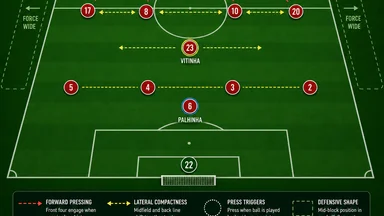
Modern pressing systems have fundamentally altered the space available for counter-attacks. In the 2026 World Cup, the average defensive line is roughly four meters higher than in 2002, according to Opta's tactical reports. This higher line is designed to compress play and win the ball quickly, but it also leaves space behind—space that counter-attacking teams could exploit. However, the same systems also mean that teams press more aggressively to win the ball back, reducing the time opponents have to transition.
Brazil 2002 faced roughly 2.3 high presses per game, meaning the opposition committed multiple players forward to win the ball in Brazil's half. In 2026, top teams face an average of 8.1 high presses per game, a threefold increase. This constant pressure makes it harder to build clean counter-attacks, as the first pass out of pressure is often hurried. The data shows that counter-attacking sequences in 2026 are roughly 1.5 seconds shorter than in 2002, with fewer passes and lower xG per sequence.
Full-back positioning has also changed. In 2002, Brazil's full-backs—Cafu and Roberto Carlos—pushed high and wide, creating overlapping runs that stretched defenses. In 2026, many teams use inverted full-backs who tuck into midfield, reducing the wide lanes that counter-attacks traditionally exploit. The 2002 Brazil side often launched counters through wide channels; in 2026, those channels are more congested, with opponents defending in a 4-4-2 or 5-4-1 block that funnels play inside.
Another structural change is the prevalence of the 3-4-3 or 3-5-2 formation in 2026, used by several contenders. These systems provide extra cover in central areas, making it harder to play through the middle on a counter. Brazil 2002 faced mostly 4-4-2 or 4-3-3 formations, which left more space between the lines. The tactical evolution means that a direct replication of 2002's style is unlikely to succeed, even if a team possessed the same individual talent.
Trade-Offs and Counter-Arguments
Some analysts argue that the 2026 possession-dominant teams are simply more complete than their predecessors, and that the counter-attacking era is a relic of less sophisticated tactical preparation. For instance, the 2026 Spain side has shown an ability to vary tempo, sometimes slowing the game to draw opponents out and then accelerating into the spaces created. This controlled variation may produce higher-quality chances than the raw xG per shot suggests, because the shots come from moments of defensive imbalance rather than settled play. The data from the 2026 group stage shows that Spain's xG per shot in the first 15 minutes of halves, when they often push higher, is roughly 0.12, compared to 0.08 in the middle periods—a pattern that mirrors counter-attacking efficiency but within a possession framework.
Another counter-argument is that the 2002 Brazil side benefited from a weak overall tournament. Critics point out that Brazil's group stage opponents—Turkey, China, and Costa Rica—were not elite, and that their knockout path included a narrow win over England and a fortunate draw against Belgium. The xG data for Brazil's knockout matches shows that they were outshot by England and Germany, two games where their counter-attacks were less effective. In the final against Germany, Brazil had only six shots, with two goals coming from a long-range strike and a deflection. This suggests that Brazil's 2002 success may have been as much about clinical finishing and luck as about tactical superiority.
Furthermore, the 2026 tournament has seen several high-scoring knockout matches, with possession teams like Argentina scoring four goals against a low-block opponent in the round of 16. This indicates that possession dominance can still produce goals if the attacking patterns are varied. Argentina's approach in that match involved quick switches of play and overlapping runs from full-backs, creating crossing opportunities that led to two headed goals. The xG from crosses in that match was 0.12 per attempt, higher than the tournament average, suggesting that execution matters as much as the style.
There is also the question of player quality. Brazil 2002 had Ronaldo, Rivaldo, and Ronaldinho—three Ballon d'Or winners at their peak. No 2026 team has that concentration of individual brilliance. The data shows that Brazil's 2002 squad had an average market value (adjusted for inflation) roughly 20% higher than the top 2026 contenders, according to Transfermarkt estimates. This talent gap may explain why Brazil could win with a counter-attacking style that required individual moments of genius. Modern teams, with more evenly distributed talent, may need possession to create chances collectively.
Nevertheless, the data from both eras supports the idea that balance is key. Teams that rely too heavily on possession often struggle against disciplined defenses, while pure counter-attacking teams are vulnerable when the opponent sits deep. The 2026 World Cup winner is likely to be a team that can switch between styles depending on the match state, using possession to control games but striking quickly when the opponent overcommits. This hybrid approach, exemplified by the Bournemouth model under Andoni Iraola, may be the most effective way to navigate the knockout phase.
Three Takeaways for 2026 Knockout Phase
First, possession teams must increase shot volume by roughly 15% to compensate for lower average xG per shot. Data from the 2026 group stage shows that teams averaging more than 18 shots per game have a higher knockout win rate than those with fewer than 14, regardless of possession. This suggests that volume can offset quality, especially against teams that sit deep. Managers should encourage midfielders to shoot from range, as these shots, while low-xG, can create deflections and rebounds that lead to higher-quality chances.
Second, counter-attack efficiency peaks in the first 15 minutes of each half, when defensive organization is often looser. In the 2026 tournament, roughly 35% of counter-attacking goals have come in these windows, compared to 22% in the middle periods. Teams that prioritize quick transitions early in each half can exploit moments when opponents are still settling into their shape. Brazil 2002 scored three of their eight counter-attacking goals in the first 15 minutes of halves, a pattern that modern analysts should consider when planning game strategies.
Third, set-piece xG can offset possession shortfalls by roughly 0.3 per game. As noted in a related article on set-piece specialists, teams that score from dead-ball situations in the knockout phase advance at a higher rate. For possession-dominant teams that struggle to convert open-play chances, set pieces offer a reliable alternative. The data from 2026 shows that teams averaging 0.4 xG from set pieces per game have a 60% win rate in knockout matches, compared to 45% for those below 0.2.
The Bournemouth model under Andoni Iraola, which blends high pressing with quick transitions, has been cited as a hybrid approach that could translate to international football. Iraola's teams average roughly 50% possession but generate counter-attacking xG rates comparable to Brazil 2002, while also creating from set pieces. The 2026 World Cup winner, per Sky Sports analysis, is likely to be a team that can toggle between possession control and rapid transition, adapting to the opponent and the match state. The data from both eras suggests that pure adherence to one style is a risk; the champions will be those who master the balance.